A workbench that shows how value is generated with stakeholders over time
A workbench that shows how value is generated with stakeholders over time.
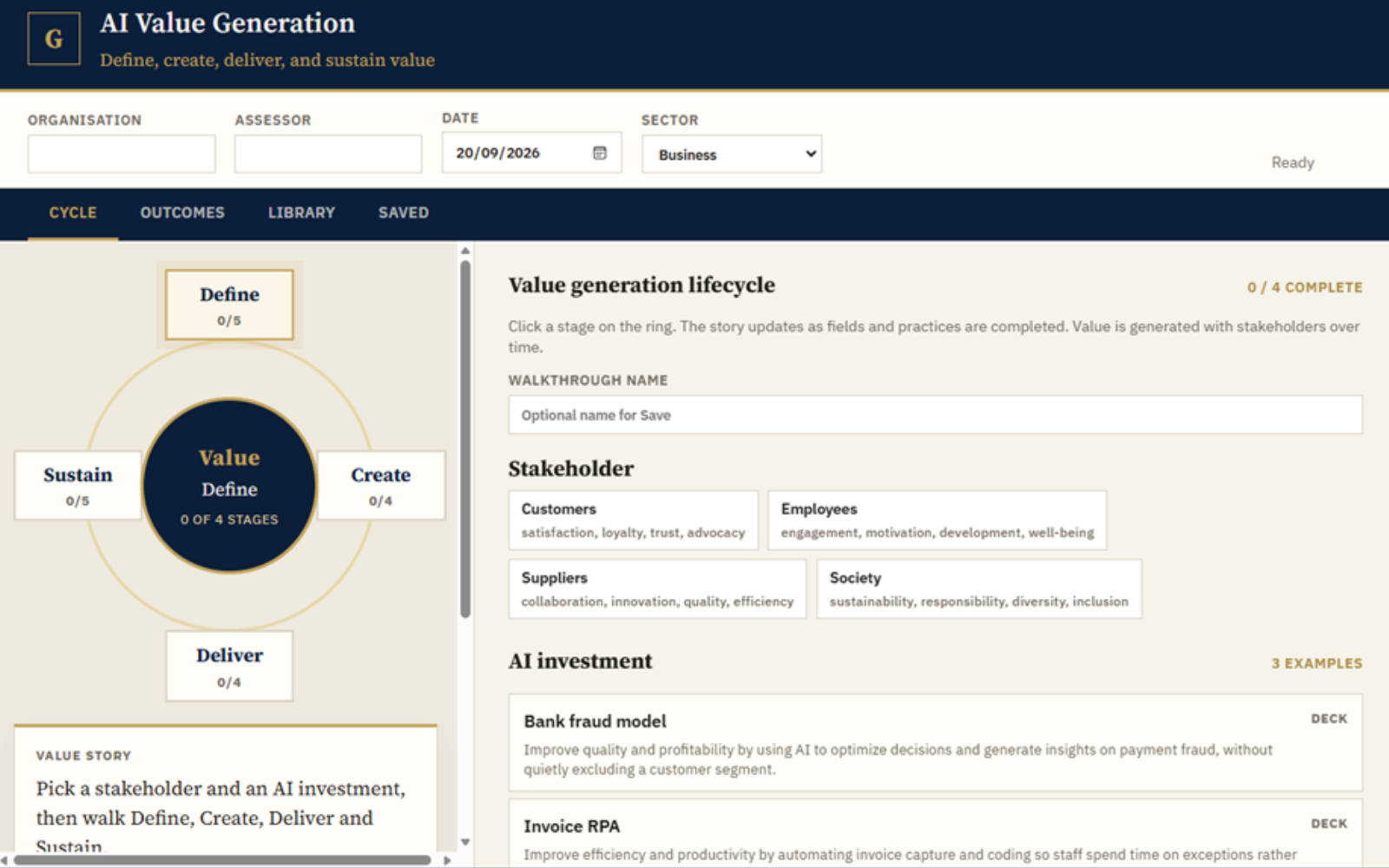
The Value Generation workbench walks one AI investment around a four-stage ring so the board can see how value is defined, created, delivered and sustained - and how it is protected when it is compromised.
Pick a sector, a stakeholder and an AI investment. Select a stage, fill the fields and tick practices. The value story updates as you go.
This module does one job: demonstrate the value-generation cycle. It sits beside Purpose and Values. Purpose answers why the organisation exists and what a named system is for. Value generation answers how that purpose is turned into benefit for stakeholders over time.
It is not an opportunity score, a financial forecast or a conformity certificate. It is a board walk of one named investment.
Boards are asked to approve AI investments as if value were automatic once a model is live. ISO 37000 treats value generation as a governing-body duty: set objectives that fulfil purpose and values, create and deliver with stakeholders, then sustain - including disclosure and redress when value is destroyed or compromised.
Without that walk, "value" collapses into a slide of expected savings. Unintended outcomes, changing context, resource cost, and harm to a stakeholder the model ignored stay off the page. The workbench keeps those in view for one named investment.
The ring matches the source deck: Define at the top, Create on the right, Deliver at the bottom, Sustain on the left, Value in the centre.
| Stage | What the board is asked to settle |
|---|---|
| Define | Set objectives that fulfil purpose and values. Identify stakeholder groups, their rights, and who controls resources. |
| Create | Set parameters. Balance objectives against impacts. Define, access and allocate resources. Optimise how they interact. |
| Deliver | The whole organisation delivers. Watch unintended outcomes and changing context. Obtain assurance. |
| Sustain | Retain and distribute value so the organisation stays agile and viable. Report transparently. Disclose where value was destroyed or compromised and how it will be redressed. Protect as well as create. |
Context chips stay visible on the ring: stakeholder expectations, regulation, technological change, and environment / social / economic conditions. The model is kept viable only if those chips can still be answered.
Value is generated with stakeholders over time - customers, employees, suppliers and society - not extracted from them in a single period.
Elements of value are functional, emotional, life-changing and social impact. More elements, stronger loyalty and revenue potential. The workbench uses that language to stop the story collapsing into cost-out alone. It is still not a forecast.
The Outcomes tab records the board's determination against three pillars directed by principles:
Practices under those pillars are tickable. They include alignment to intended purpose, communicated value objectives, governing-body accountability regardless of delegation, assurance that processing still matches purpose, and disclosure when value is compromised.
A completed walkthrough should answer, in plain language:
Save a walkthrough to keep a named record. Store the value story with the AI system's evidence pack. Treat it as a board walkthrough - how value is generated with these stakeholders.