The governing body should lead the organisation ethically and effectively and ensure the leadership principle is turned into a practical board walk for one named AI system.
Leadership of AI is often reduced to a sponsor's name on a slide. The system then runs under management while the board is told that "governance is in place." Stakeholders have no evidence that anyone at the top directed the system ethically, committed to control and assurance, behaved consistently with stated values, or ensured that leadership lasted the life cycle.
ISO 38500 leadership asks more than endorsement. The governing body must:
Without that exploration, responsibility does not match authority, decision-making is opaque, and conformity is invisible until something fails.
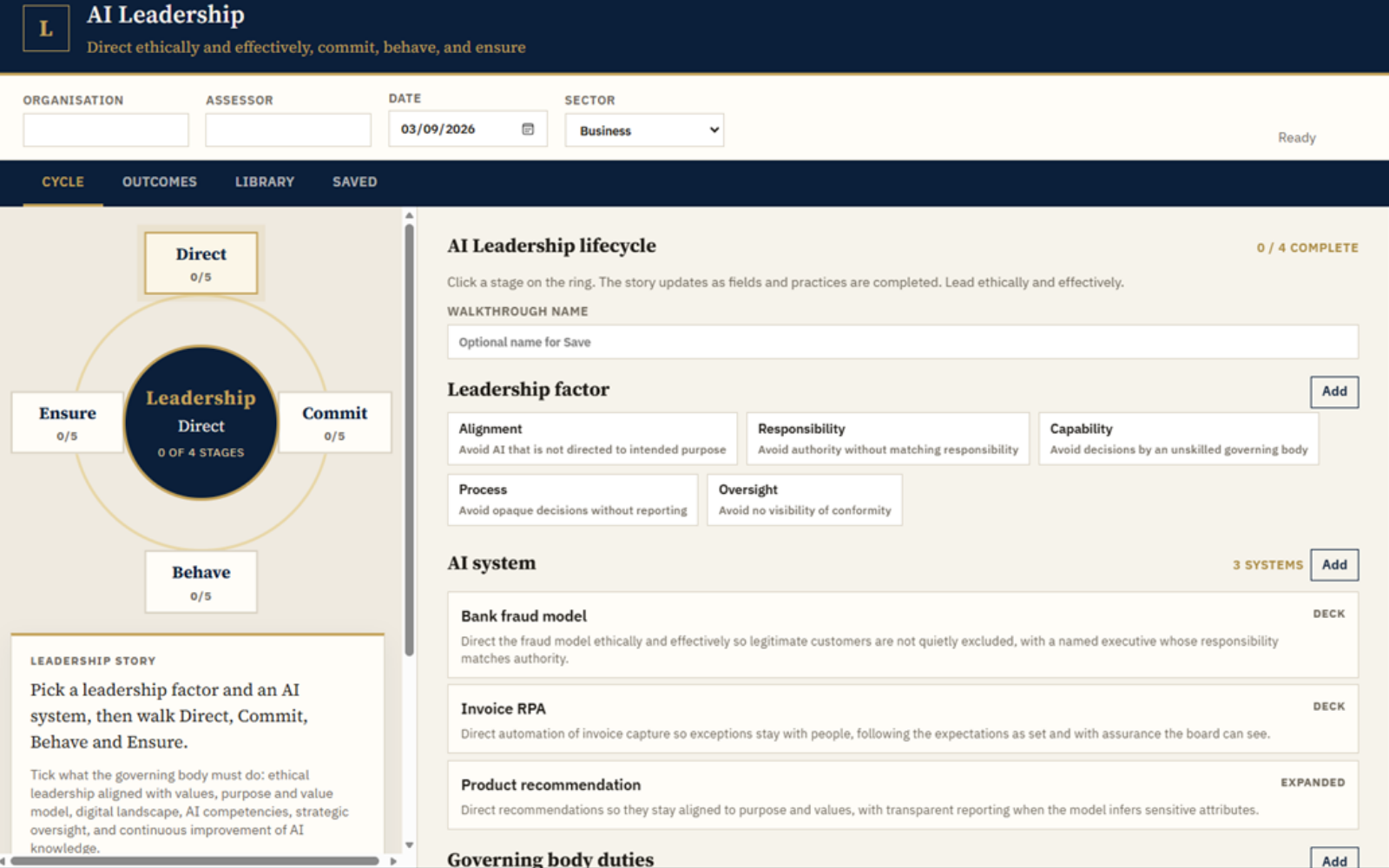
The AI Leadership workbench provides a structured walkthrough for the governing body. It takes one named AI system through four stages. Sibling workbenches cover purpose and values, ethical fit, value creation, value generation, model value and viability. This module does one job: leadership.
The lifecycle matches the principle: Direct at the top, Commit on the right, Behave at the bottom, Ensure on the left, Leadership in the centre.
| Stage | What the board is asked to settle |
|---|---|
| Direct | Direct the AI system ethically and effectively. Define purpose and the value model. Communicate the digital landscape (technical documentation). Align ethical leadership with organisational values. |
| Commit | Demonstrate commitment to the internal control system and assurance processes. Direct how management communicates AI risk policies and statements to stakeholders, so they can have confidence that AI is developed and used responsibly. |
| Behave | Behave in a manner consistent with defined organisational values, and follow the expectations as set. Alignment to intended purpose. Responsibility matches authority. Decision-making is skilled, transparent and reported. |
| Ensure | Ensure such leadership throughout the AI system's life cycle. Assess the governing body's AI competencies, oversee strategic decision-making, continuously improve AI knowledge, and keep visibility of conformity. |
A stage is complete when its story field is filled and every practice is ticked. The walk can be paused, saved and resumed.
The walk is anchored on the important factors relating to leadership:
| Factor | What it requires |
|---|---|
| Alignment | Intended purpose - leadership is toward a specified use, not a generic "AI programme". |
| Responsibility | Responsibility matches authority. No unowned high-risk path. |
| Capability | Decision-making is skilled. The body assesses its own AI competencies. |
| Process | Transparency and reporting. Decisions can be reconstructed. |
| Oversight | Visibility of conformity across the life cycle. |
Governing-body duties stay visible on the walk: ethical leadership aligned with values; purpose and value model defined; digital landscape communicated; AI competencies assessed; oversight of strategic decision-making; continuous improvement of AI knowledge.
The Outcome records the board's determination of which results of leading AI apply:
Leadership becomes a board artefact. A named system then has a written account of how it was directed, what the body committed to, how it behaved, and how leadership is ensured after go-live. That account can sit in the evidence pack beside purpose and value.
Commitment is visible to stakeholders. The governing body directs how management communicates AI risk policies and statements. Demonstrating that leadership is how stakeholders gain confidence that AI is developed and used responsibly - not by assertion.
The body assesses itself. Ensure includes the governing body's own AI competencies, oversight of strategic decision-making, and continuous improvement of AI knowledge. Leadership is not delegated downward and then forgotten.
Responsibility matches authority. Behave tests whether the person or body that can stop the system is the same as the person or body that is accountable for it. A high-risk path with no matching authority is a leadership failure, not an operations issue.